Reading & Phonics
Reading & Phonics at OKQA
Intent: The aims of English at OKQA are:
- To create opportunities for adult and peer interactions and joint attention
- To offer students a range of communication tools and strategies to enable them to communicate their needs effectively
- To develop students’ vocabulary and understanding
- To enable students to express their emotions more effectively
- To foster an enjoyment of stories, literature and drama
- To explore students’ special interests through literature, speech and play
- To learn to attend to a range of group sessions and assemblies
- To learn about a range of topics centred around a class book or story
- To enable cultural inclusion through exposure to a range of authors, genres and traditions
- To teach functional reading, writing and communication skills to enable them to be more independent in the local community
- To develop functional reading, writing and communication skills for life skills and employment opportunities
- To offer older students the opportunity to gain qualifications relating to English
Implement: In delivering the curriculum OKQA uses a multi-sensory, topic-based approach that is adapted whenever possible to suit each student’s unique interests and strengths.
- Students follow personalised English programmes, taught through a blend of discrete lessons, integrated topic-based learning, and learning opportunities woven throughout the school day.
- Topics and schemes of work are reviewed regularly where there are aspects of English teaching and learning
- The Speech and Language team regularly review the Total Communication Approaches, AAC supports throughout the school, including opportunities for communication development in the playground and at lunchtimes.
- Staff training is held regularly on a variety of topics related to English, for instance, Phonics, sensory stories and Total Communication approaches
- Lesson observations, as well as focused learning walks support the development of English teaching
Impact: Progress in English is assessed annually through EHCP review and termly through (PLP) Personalised Learning Plan targets.
- All students have an English target and two social communication targets (from SCERTS) per term. These are agreed in collaboration with class teams, phase leaders, parents and speech and language therapists. Staff will consider children’s EHCP outcomes and create small steps of learning and progress towards these.
- Engagement in English based activities is often related to the social communication, joint attention and emotional regulation areas of development as well as reading, writing and communication.
- Development of reading, writing and communication skills is embedded across the curriculum and the school environment.
- Themed learning walks look at the impact of English teaching across the school
- The goal of progression is to guide students toward their ultimate pathway—PFA—and to develop the skills necessary for independent living.
Key components of Phonics & Reading at OKQA
For autistic students, reading may be interpreted as any activity that leads to the derivation of meanings from visual or tactile representations, for example, objects, pictures, symbols or written words.
These may be accessed visually, orally and/or through touch, for example, looking at objects, pictures, symbols or words, feeling objects of reference, looking and listening to songs or computer programs, listening to an adult reading aloud or recordings.
Students at OKQA are taught a range of strategies to enjoy, to access and to understand different types of symbolic representations, such as objects of reference, pictures, symbols and text or any combinations of these.
As with all curriculum subjects, we use a multi-sensory approach tailored to the individual student’s interests and strengths. We identify how the student learns and personalize the curriculum and our teaching approaches for each student. For many of our students, this starts with developing their joint attention skills and engagement in activities as these are essential precursors for academic attainment.
When teaching phonics we:
- are aware that it is not a ‘one size fits all’ approach for our students.
- Use our professional judgement about what programme to follow and how to adapt this (L&S or SSP).
- Ensure progression by working through the programme at a pace that is right for our students, building on previous phonics mastery and documenting success.
- Are aware that it is imperative to pronounce sounds correctly (‘pure sounds’). How to pronounce pure sounds | Oxford Owl (https://www.youtube.com/watch?v=UCI2mu7URBc)
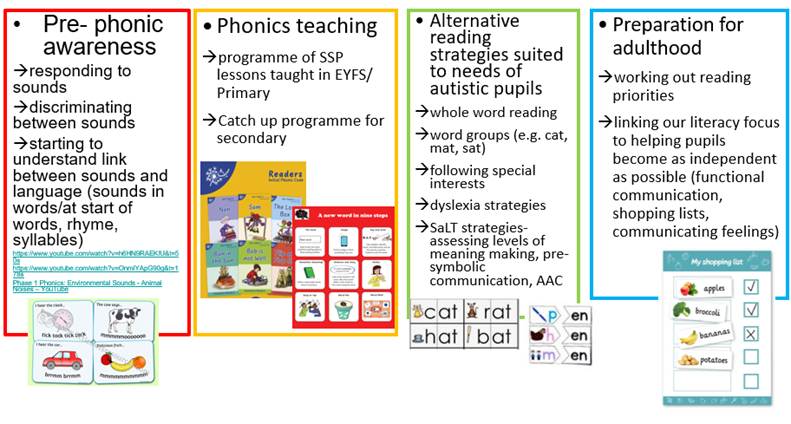
Pre-phonic awareness
Taken from Letters and Sounds Phase 1.
Focus on early sound awareness and sound discrimination.
Teachers develop students’ sound awareness following the progression as set out in Letters and Sounds:
- Environmental sounds
- Instrumental sounds
- Body percussion
- Rhythm and rhyme
- Alliteration
- Voice sounds
- Oral blending and segmenting
This approach is most suited to SP (social partner) students. Ideas for teaching and learning activities are worked up in the school’s phonics scheme of work.
Phonics Teaching
Tailoring our phonics scheme is an ongoing work in progress. It is under constant review but has been thoughtfully and carefully crafted, designed around the body of evidence that supports the teaching of reading through SSP as well as many years of experience gained from ‘what works’ with students in our setting. Ideas for teaching and learning activities are worked up in the school’s phonics scheme of work.
We are currently using a SSP programme linked to Dandelion readers (Phonicsuk). Dandelion readers have a comprehensive set of reading books focusing on the Initial Phonic Code and the Extended Phonic Code which offer students a structure format to consolidate sounds/decodable reading words at the end of each set/group of sounds.
There is:
- A whole school approach to teaching word reading through SSP, where this is accessible for students.
- Focus on explicit teaching of GPC and how to segment and blend CVC words.
Alternative reading strategies suited to needs of autistic pupils
- whole word reading
- word groups (e.g. cat, mat, sat)
- following special interests
- dyslexia strategies
- S< strategies- assessing levels of meaning making, pre-symbolic communication, AAC
- Interweave alternative strategies to support with development and enjoyment of early reading. This is especially important in cases where phonics might not work (e.g., whole word readers, secondary aged students at the SP stage).
- Personalised resources to entice.
- Dyslexia strategies include a focus on word families, onset and rime and spelling patterns.
- Ongoing collaboration with S< to assess communication skills and plan for increased opportunities for communication in lessons and across the day.
Preparation for adulthood
- working out reading priorities
- linking our literacy focus to helping pupils become as independent as possible (functional communication, shopping lists, communicating feelings)
- Curriculum shift to PFA and functional English for all students from Year 10.
- Students may revisit SSP work, but teachers do not rely on this (it is not suitable for some older autistic learners with limited/no verbal expression).
- Reading priorities for older autistic students are largely determined by communication partner stage with focus/activities varying across both partner stage and OKQA setting (e.g., Social Partner PFA practical reading activity).
What English might look like for a Social/pre-formal Partner
- Being part of a group attending to a story or English activity
- Exploring sensory stimuli relating to reading, writing, communication and stories
- Using symbols, photos or pictures to indicate a want, need or to make a choice
- Understanding and following a schedule
- Mark making using a variety of tools
- Participating in a range of functional activities such as cooking and shopping
- Accessing a range of community outings
- Experiencing the written word all around them
- Requesting more of something
- Following short verbal commands or instructions
- Imitate a range of sounds
What English might look like for a language/semi-formal partner
- Attending to a group writing or story-telling activity
- Indicating some wants, needs or preferences through speech, symbols or gesture
- Intentional and meaningful mark making using a variety of tools
- Commenting on events, activities or objects
- Developing independence in a range of functional activities such as cooking or shopping
- Accessing the community with greater independence
- Matching letters, pictures and/or words
- Sequencing events or parts of a story
- Writing some words such as own name
- Verbalise some familiar words or sounds
- Identifying writing in the world around them
What English might look like for a conversation/formal partner
- Attending to and participating with a range of English activities
- Clearly indicating a range of wants, needs or preferences
- Turn taking in a conversation about a range of topics
- Independently following written instructions to complete a variety of functional activities
- Accessing familiar community activities and places independently
- Decoding a range of words using phonic understanding
- Reading and writing some phonic based CVC words
- Using a dictionary to self-correct or learn new words
- Reading and writing a variety of styles, purposes and for different audiences
- Asking and answering questions about text